
Set this page to:
Go to FERI in:


T +49 (0) 6172 916-3097
info@feri-institut.de
Rathausplatz 8 - 10
D-61348
Bad Homburg
CONTACT
CONTACT
 Languages

The war in Iran has long had repercussions far beyond the region. Second- and third-round effects along global energy and supply chains make geopolitical escalations a systemic risk to the global economy.
The war in Iran is no longer a purely regional event. Its true explosive power is unleashed through second- and third-round effects that have a profound impact on global energy, supply, and pricing systems.
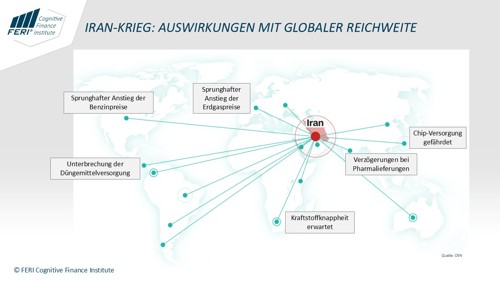
What began as a regional escalation is now spreading in a cascade along key value chains—with global repercussions. Energy prices are reacting sharply to the increased geopolitical risks. As a result, energy- and resource-intensive sectors are coming under pressure.
Second-round effects particularly affect fertilizers, chemicals, raw materials, and chip production. In a further stage, these pressures are impacting prices, margins, and investment decisions. At the same time, financial markets are reacting with increasing uncertainty and heightened volatility.
What matters here is not the individual shock, but the chain reaction within a highly interconnected economic system. Rising energy and transportation costs act as a key transmission mechanism through which regional conflicts become structurally globalized.
The FERI Cognitive Finance Institute warned of precisely this risk of escalation as early as 2025 in an analysis. According to the analysis, the global economy is structurally concentrated in a few highly sensitive chokepoints, including, in particular, the Strait of Hormuz. These maritime bottlenecks act as multiplicative stress points where geopolitical tensions rapidly translate into global economic shocks. Regional escalations can rapidly take on global proportions there.
The war in Iran today serves as a striking confirmation of these scenarios. An escalation at a single choke point is enough to destabilize energy, supply, and financial systems simultaneously. While the high degree of interconnectedness in the global economy boosts efficiency, it also increases vulnerability to systemic chain reactions. Geopolitics thus has a direct, rapid, and structural impact on economic processes—no longer with a time lag.
Conclusion:
Global choke points represent a new dimension of geo-economic risk that has become strategically relevant for companies, investors, and policymakers.
For further reading: The Cognitive Briefing „Global Choke Points – Maritime Engpässe als unterschätzter Risikofaktor für Weltwirtschaft und Geopolitik“, available in German for download on this page.
T +49 (0) 6172 916-3097
Rathausplatz 8 - 10
D-61348 Bad Homburg